This is the first post in a short and occasional series about how I take my garden photographs. I’m not an expert in garden photography, but after being asked the question, I thought I could share my thoughts on how I take my photographs. I hope you’ll join in and put your ideas forward as we all photograph in different ways, whether with a camera or a phone. Your conversations will be most welcome.
The Magic Of Low-Angle Flower Photography
We’re all accustomed to looking at plants and flowers from our own height but one recent post raised some comments I thought I’d address in this first post. When you get down to the level of a short flower or plant, you see it differently – more beautifully. It’s more akin to looking at a vase full of lovely flowers on a table – they’re closer to eye level. Here is a little insight into how I approach taking photos of low-growing flowers and plants.
Get Down Low
First of all, I need to tell you a little bit about the camera I use, and how it helps me to get eye-level flower shots. The photo below was taken purely to show the flip screen on the camera. This is indispensable to me when photographing plants and flowers at their own level. You can also use the techniques explained below with a camera phone.

My knees have been through a lot – so many injuries in the past, and now the dreaded arthritis has set in. Kneeling is out of the question for me, so when I’m taking shots of smaller plants in the borders, I use my trusty garden stool, or a nearby garden chair if it’s the right height.
The camera is held fairly low and as a consequence, it’s not being held in a natural position. I brace the camera, either on my knee, between the knees or if the flower is very short I grab an overturned plant pot & bean bag to balance the camera and hold it steady. Would it be easier to use a tripod? Perhaps that is the choice for some of you, but I prefer hand-holding the camera whenever possible as I find it faster and more flexible to work that way than with a tripod.
For those of you who still have healthy knees, you have it easy! Pop a kneeler down and start shooting! And for the young and fit, grab a yoga mat and stretch out on your tummy, camera in hand – you’ll find that your elbows make a fairly decent tripod and you’ll see those gorgeous flowers in a whole new way!

For the shots of the fritillaries, I was seated with the camera held below knee level. The light was falling and the camera settings were ISO800, f5.6, 1/80 sec. There was a strong breeze, I had to wait for each gust to pass. The camera was braced against one leg to avoid camera shake. Focus was selected by using the camera’s focus lever and focus set using back focus. I’ve only recently started using back focus, and although it’s taking a while to get to grips with it, I feel I’m getting better results. I can cover more about this in a separate post if anyone is interested.
You’ll spot similarities and differences in the two photographs below. I had just returned from the garden centre with some pots of fritillaries and rain was threatening. I didn’t know where the fritillaries were being planted, so I photographed them in various locations while they were still in their pots. Use the slider to see both images.

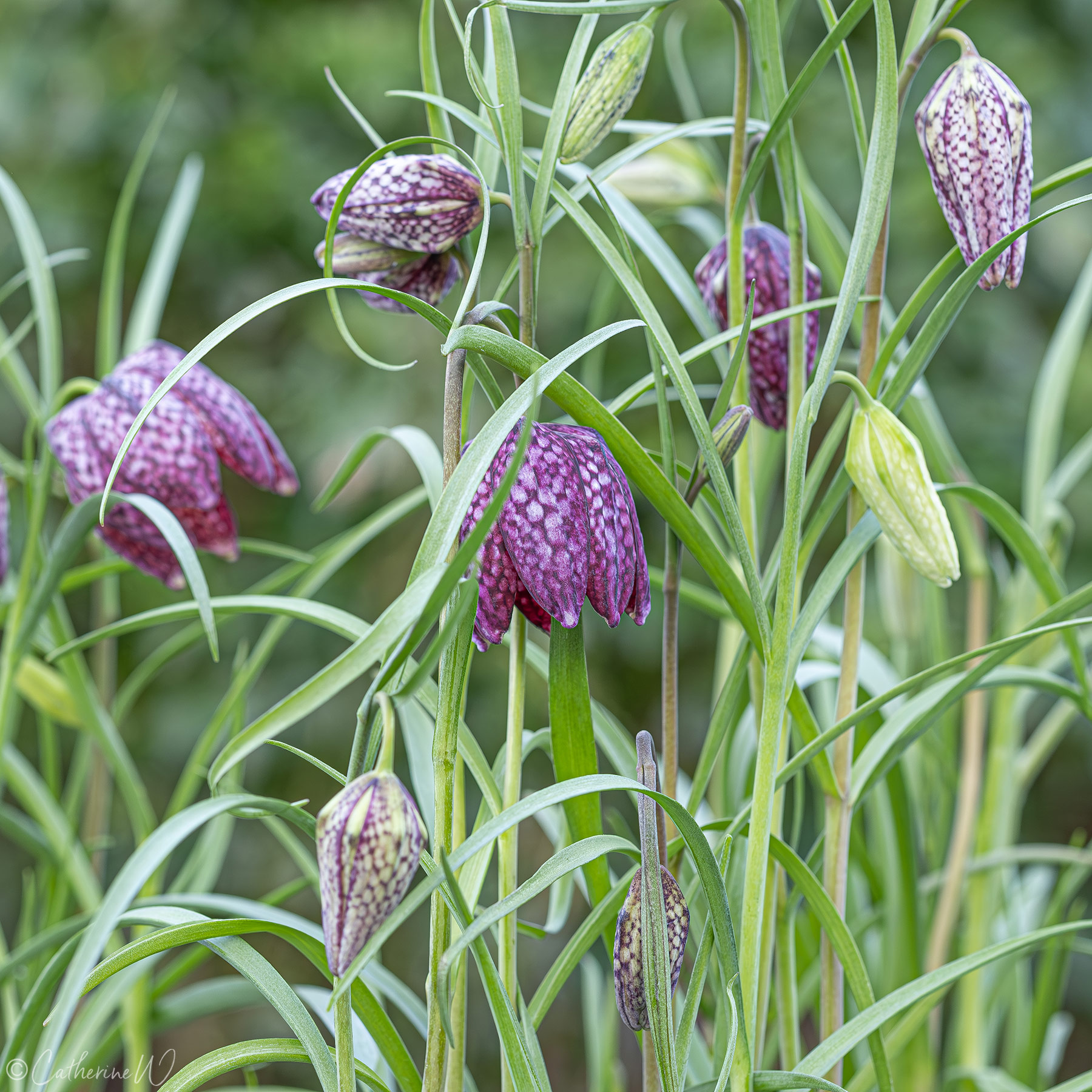
In the first shot, the fritillaries were in a border with Hellebores in the background. Because the camera was held low, the pots were easily kept out of the frame. The second shot has shrubs in the distant background.
The photos below are from previous years. The same technique of holding the camera low was used.

Below: the camera is low with the lens focusing directly onto the tulips on the left. The low level emphasises the height of the Forget-me-nots.

Finally, tulips are a fabulous subject to get up close and personal with. This seated shot is from April last year.

I hope this very short explanation of my low-level technique is helpful to you. If you have any questions, feel free to ask. Happy photographing!
Catherine 😊


Thank you for teaching us your photography technique. It’s a good solution to place the camera on your knees or on a pot. For my part, I don’t use a tripod but I often lie down in the grass (as long as I can and the grass is not too wet!! 😂) . The comparative photos of the fritillaries yesterday are interesting, I prefer the first one because it brings out the contrasts and colours much more , but it’s a question of taste
LikeLiked by 1 person
Oh to be able to lie down on the grass with a camera in hand! 😁 They do say though, that for every problem there is a solution, don’t they. I’m still not sure which spot to put the fritilliaries in but I’ll have to decide soon.
LikeLiked by 1 person
And I’m probably younger than you to be able to still lie down on the grass …
LikeLiked by 1 person
Oh, I imagine you are, Fred! 😂
LikeLiked by 1 person
Thank you Catherine, very useful tips. I need all the help I can get with photos!
LikeLiked by 1 person
Thanks, Rosie. I hope you’re having a good weekend! At last we have blue skies here – and the wind has dropped. I’m going out now to pot up a delivery of new herb plants!
LikeLiked by 1 person
Great tip. Taking a “horizontal” shot can take some ingenuity.
LikeLiked by 1 person
There are times when it can be challenging! 😁
LikeLike
For someone like me, who want to improve their photography, this is really interesting – thank you. And yes, I would be interested in back focus please: I’ve just Googled it and I think you would probably explain it better than anything I’ve found so far!
LikeLiked by 1 person
There are a number of good YouTube videos about back focus, Helen and I’ll attempt to do a post on the topic a little bit down the line. I’ll include the best videos and post links to them.
LikeLiked by 1 person
I look forward to re reading and taking in a wealth of information tomorrow and hopefully with camera in hand go out a try this out. Thanks for the tips and guidance Catherine.
LikeLiked by 1 person
Good luck with your trial run, Noelle – I hope you have decent weather today! 😊
LikeLike
The shot of the orange tulips is amazing. I like the way you have captured those in the foreground and the blue forgetmenots and purple tulips fade into the background. Clever shot. I mus try harder!
LikeLiked by 1 person
Thank you! 😊 I’m glad you like Tulip Ballerina – she’s a beauty. I see the bulbs coming through the compost in the pots now, so there’s hope ahead for Spring tulips!
LikeLike
I was taking shots of my rockery in progress this afternoon tried to take a low shot, stepped back for a better angle and narrowly missed falling in the pool. LoL… I’ve not checked the shots yet. We will see. >)
LikeLiked by 1 person
Oh dear! 🫣That would have been unfortunate, and I would have been black-listed! 😂 I hope your photos were worth the fright!
LikeLike
Helpful tips Catherine. Your photos really are always lovely!
LikeLiked by 1 person
Thank you, Cathy. Many readers will already be aware that photographing flowers at the flower’s level can give lovely results and already photograph low. I just hope it helps a few, who perhaps only photograph from above to think a little differently and perhaps give it a go.
LikeLiked by 1 person
I enjoyed your post Catherine. I have mobility issues and like you am no longer able to kneel. Well if I did I would never get up! Your overturned plant pot and bean bag tip is brilliant. I did have a camera with a flip screen which was an invaluable feature but sadly that camera is no more. These days I have got in the habit of using my phone but must dig my camera out of the cupboard where it has been lingering far too long. I look forward to your next photography post.
LikeLiked by 1 person
Oh, I’m like you, Anna – I’d have to be helped back to my feet! I use my phone too when I’m out walking with family, or on holiday – and I always regret it when we go to a lovely garden during the day! But in the garden – the camera rules. 😁
LikeLike
Great tips, and great photos, as always! That last shot of the Tulips and Forget-Me-Nots is magical. Sigh…
LikeLiked by 1 person
Thanks Beth, I hope you found something of use in the blog post
LikeLike